Writing
Flattening the (sampling) curve
Fitting a map to Newton's method to get a uniform distribution and white noise autocorrelation
So what did you do on your Saturday night Paul?
Well after my previous post on a pathological version of Newton's method, I got obsessed with Shahmeer Khurram's question about arbitrary maps and I thought to myself, well the logistic map is pathological, but maybe not pathological enough. What we need is more pathology!
The inversion itself is straightforward, you can just rearrange the Newton formula for a desired map M to give
f(x) = C exp(∫ dx/(x − M(x)))
and I thought "the logistic map is cool and all, but what we want is a uniform distribution over (0,1) and a dead autocorrelation", and so I present
- Logistic Newton
f(x) = ∛(4 − 3/x)
gives
xₙ₊₁ = 4xₙ(1 − xₙ)
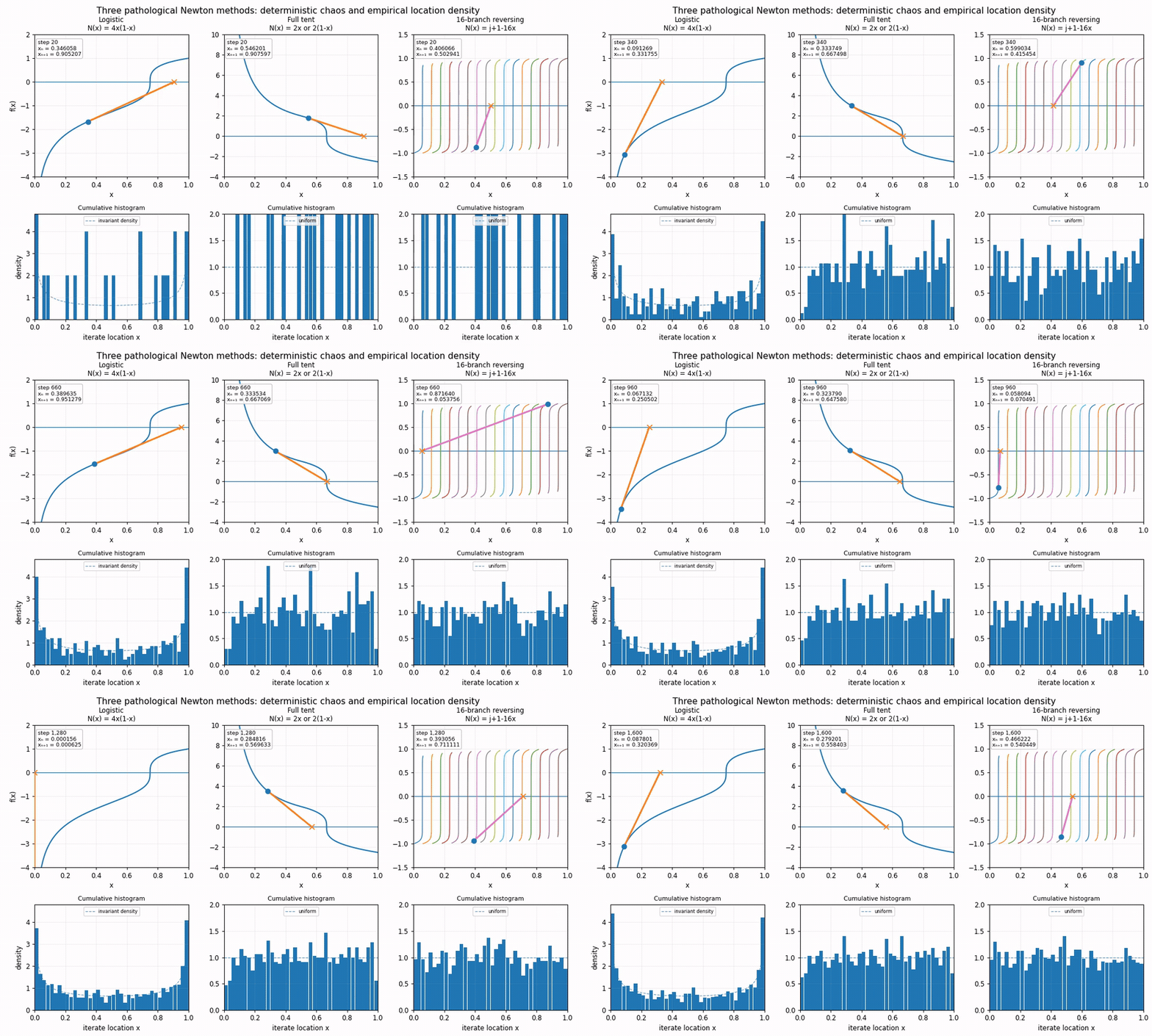
So Newton’s method is the chaotic logistic map. Its iterations don't fill (0,1) uniformly though :( they converge to
ρ(x) = 1/(π√(x(1−x)))
which is the U-shaped histogram in the first panel.
- Tent map Newton
f(x) = 1/x for x ≤ 1/2 and f(x) = −2^(4/3) ∛(3x−2) for x > 1/2
gives
xₙ₊₁ = 2xₙ for xₙ ≤ 1/2 and xₙ₊₁ = 2(1−xₙ) for xₙ > 1/2
this has a real root at 2/3 but chaotic orbits that are uniform over (0,1), and it's auto-correlation looks like white noise
- Some 16 Branch monster
A thing of numerical analyst nightmares
On branch j = 0,…,15
j/16 ≤ x < (j+1)/16
take
f(x) = sgn(17x−j−1) |17x−j−1|^(1/17)
Then Newton gives exactly
xₙ₊₁ = j + 1 − 16xₙ
this has 16 real roots at
x = 1/17, 2/17, …, 16/17
it has a Lyapunov exponent of
λ = ln 16
is uniform over (0,1) and a whole family of standard correlation tests would say is white noise.
This one is just silly.
I think it is time for me to stop now.